
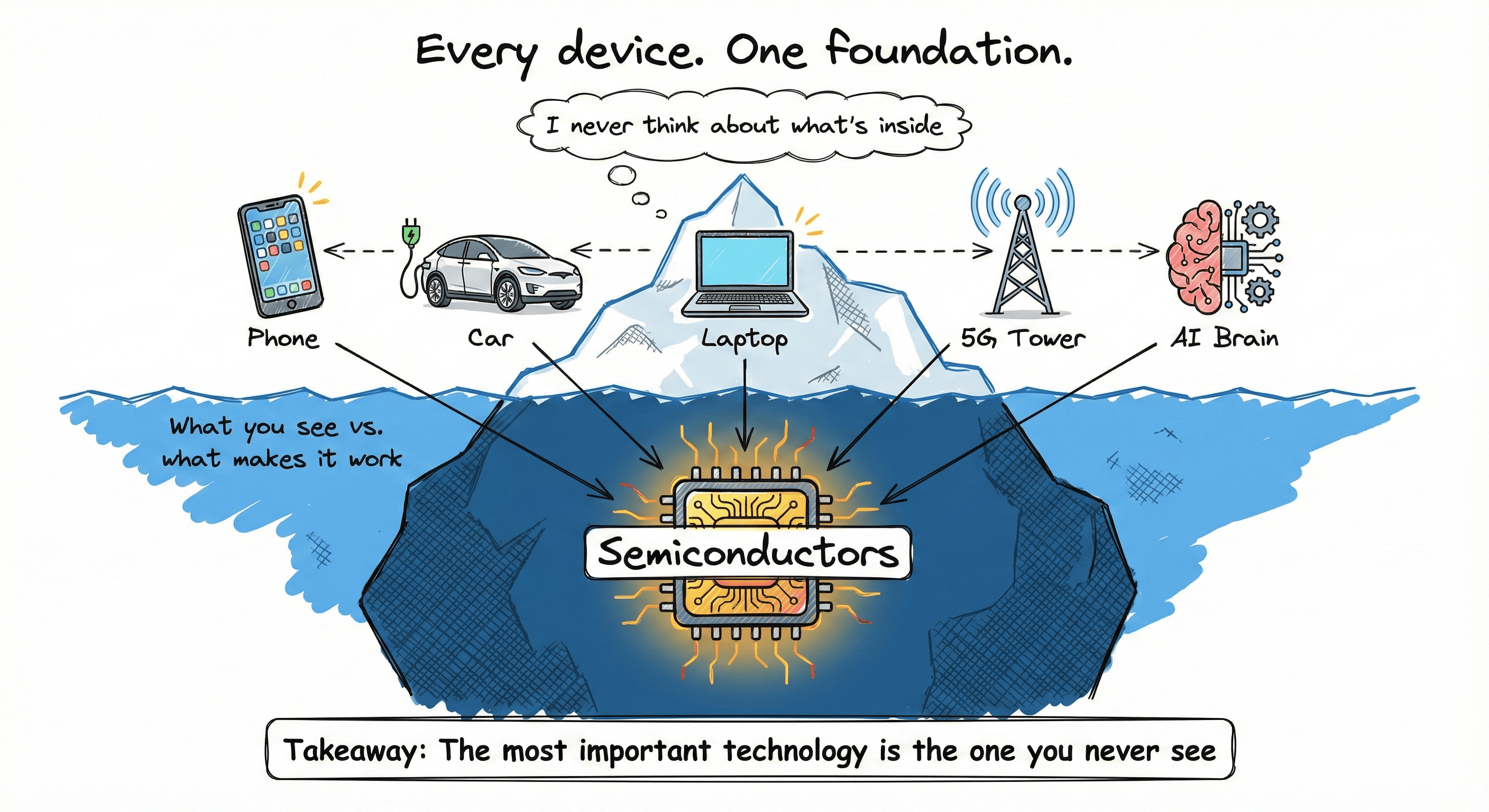
Every device you touch, every app you open, every AI that annoys you with "As an AI language model..." there's one thing connecting all of it and that is Semiconductors.
I've been trying to wrap my head around this industry for a while now, and honestly? The more I dig, the more I realize how few people truly understand the thing that makes everything else possible. We talk about AI revolutions and 5G and electric cars, but nobody talks about the microscopic pieces of silicon making all of it work.
Let me try to explain what I've learned.
Strip away all the jargon, and a semiconductor is basically a tiny piece of silicon covered in millions of switches. Each switch can be on or off — 1 or 0. That's it. That's the whole magic trick.
These switches are called transistors. Arrange enough of them on a chip, and you get an electronic language that lets processors talk to memory, lets your phone render that Instagram video, lets an AI generate another mediocre poem about sunsets.
The first transistor was invented at Bell Labs in the late 1940s.
Not all chips are created equal.
Memory chips — things like DRAM and NAND are basically storage. They're commodities. Mass-produced, less customized, cheaper. Samsung, SK hynix, and Micron dominate this space.
Logic chips — your CPUs and GPUs — are where things get complicated. These do the actual thinking. They process data, run calculations, power AI models that consume ungodly amounts of compute. NVIDIA lives here, printing money on every GPU shipped.
The interesting thing? Memory is a volume game. Logic is a complexity game. Different economics, different players, different strategies.
Here's where it gets fascinating with the business operating model.
For decades, companies did everything in-house. Design, manufacturing, sales — all under one roof. This was called IDM (Integrated Device Manufacturer). Intel was the poster child. Vertical integration. Total control.
The advantage? You own the quality. You own the IP. You move fast.
The problem? Building a chip fabrication plant costs somewhere around $20 billion. That's not a typo. Twenty. Billion. Dollars. Per fab.
So companies started splitting up.
Some became design-only firms. They'd create the chip architecture, then ship the designs off to someone else to actually manufacture. NVIDIA does this. AMD does this. Qualcomm does this. They're called "fabless" companies.
Others became foundries — factories that manufacture chips for anyone who pays. TSMC in Taiwan became the king of this model. They don't design their own chips. They just build everyone else's. Brilliantly.
This separation changed everything. Suddenly, a startup with a clever chip design didn't need $20 billion to bring it to market. They just needed TSMC's phone number.
If TSMC is the manufacturer, there's one company that makes manufacturing even possible: ASML.
ASML, based in the Netherlands, is the only company on Earth that makes EUV lithography machines. EUV — Extreme Ultraviolet — is the technology required to print the most advanced chips. Without it, you're stuck making chips from 2015.
Let me say that again: there is exactly one company that can make these machines. If ASML stops shipping, or if export restrictions block their machines, the entire global semiconductor industry hits a wall.
This is the bottleneck nobody talks about.
Governments finally woke up.
Japan figured it out first. In the 1970s and 80s, the Japanese government poured support into domestic semiconductor companies, making them globally dominant. American companies were getting crushed.
The U.S. fought back with trade agreements in 1986, trying to end dumping and force Japan to buy American chips. Tariffs went up. Tensions rose.
But here's the twist: while America and Japan were fighting, Taiwan and Korea quietly slipped in and built empires. TSMC was founded in 1987. Samsung pivoted hard into memory and logic.
Now look at the map. TSMC in Taiwan manufactures chips for nearly every major American tech company. Taiwan became strategically essential overnight — not because of politics, but because of 7nm process nodes.
America is scrambling to bring manufacturing back home. The CHIPS Act is throwing billions at domestic fabs. Intel is trying to reinvent itself as a foundry. But you can't rebuild an ecosystem in three years that took Taiwan three decades to perfect.
Speaking of ecosystems — Silicon Valley didn't happen by accident. Well, it kind of did.
It started with Shockley Semiconductor in 1956. William Shockley — yes, one of the transistor inventors — started a company in Mountain View. He was, by all accounts, a terrible manager. Eight of his best engineers quit in frustration.
They called them the "traitorous eight."
Those eight founded Fairchild Semiconductor. And from Fairchild came Robert Noyce and Gordon Moore, who left to start Intel. From Intel came spinoffs. From spinoffs came suppliers. From suppliers came software. From software came platforms.
A flywheel formed: toolmakers, manufacturers, designers, software companies, venture capital — all in one geographic cluster, all feeding each other. Stanford linked research to industry. Talent circulated between companies. Everyone knew everyone.
This agglomeration — clustering of expertise and capital in one place — became the model everyone tries to copy. Austin. Boston. Shenzhen. None have fully replicated it.
China produces memory chips. They're accelerating on logic. But they haven't caught the frontier yet.
What China does have is scale. Manufacturing capacity. Cheap labor. Companies looking to maximize margins flock there because production costs drop dramatically.
But the U.S. is playing defense. Export restrictions. Sanctions. ASML can't ship its most advanced machines to China. Every few months, another restriction tightens the screws.
Whether this slows China down or just forces them to build domestic alternatives — that's the trillion-dollar question nobody can answer yet.
Here's what stays with me:
Every app on your phone, every cloud server running your code, every AI model generating text — it all traces back to tiny switches on silicon. Millions of them. Billions of them. Manufactured in fabs that cost more than some countries' GDP, using machines made by exactly one company in the Netherlands.
We built a global technology civilization on a supply chain that runs through a single island in the Pacific.
If that doesn't keep you up at night, you're not paying attention.